
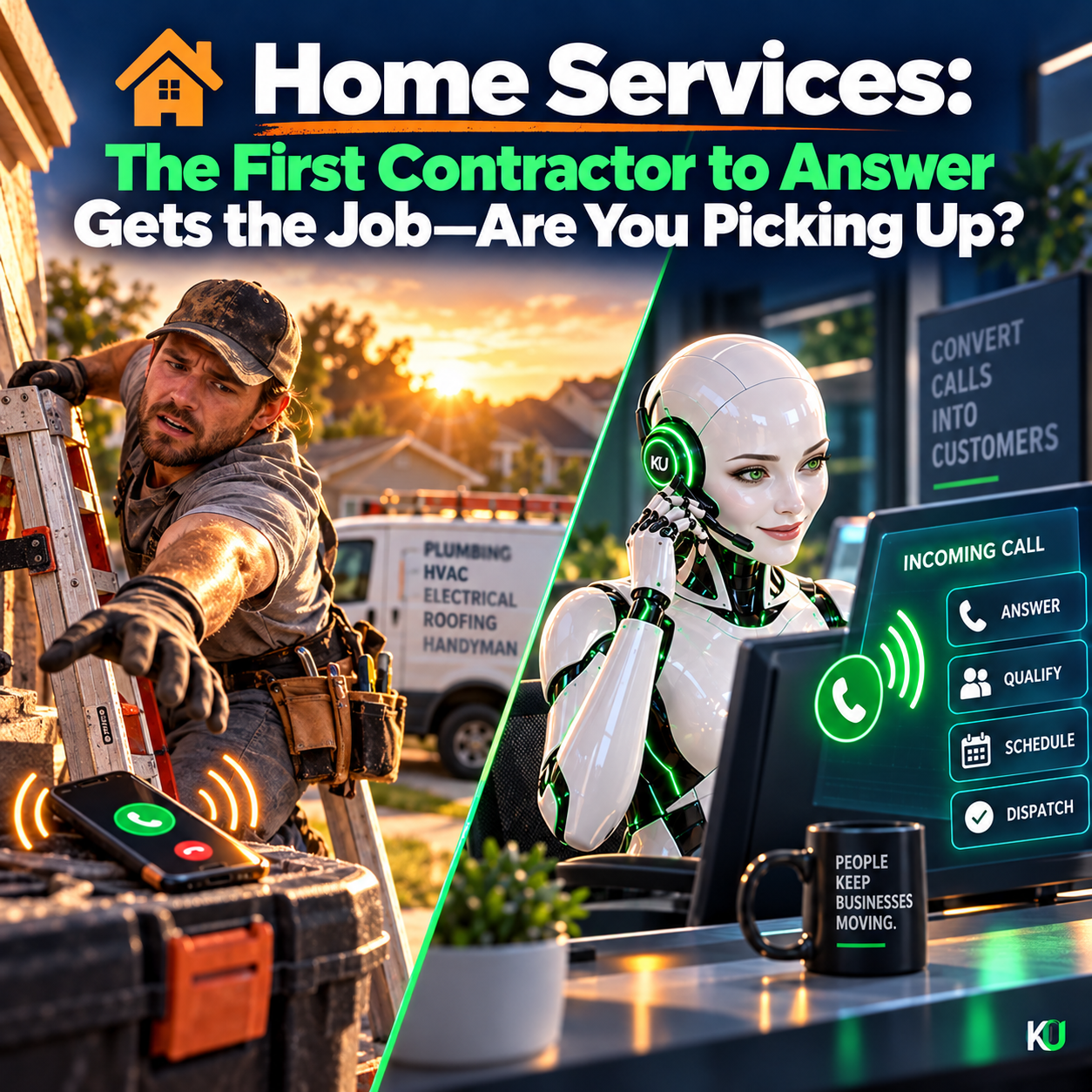
If a homeowner has a leak, a dead furnace or a scary electrical issue, they don’t sit down and carefully compare three bids.
They call the first few contractors Google gives them… and whoever answers first usually gets the job.
If you’re in home services, that’s the real problem: not your skill, not your reviews, but whether you pick up the phone when it matters.
The call you missed is a job you never see
Most home service owners think the big risk is doing a job badly.
In reality, the bigger risk is never getting the job in the first place because the caller gave up.
Here’s what happens in the real world when someone’s in a pinch:
They search “plumber near me” or “HVAC repair emergency”.
They tap the first number.
If it goes to voicemail, they hang up and tap the next number.
If it rings and rings, same thing.
If someone picks up quickly, listens, and sounds competent, the search ends right there.
You never see the calls that don’t reach you. They don’t show up as “lost jobs” in your system. They’re just… gone.
And that’s why it’s easy to underestimate how much business is quietly slipping through your fingers.
Why homeowners won’t wait for you
From your side, missing a call can seem harmless.
You tell yourself you’ll return it later.
You assume they’ll leave a message if it’s urgent.
You trust that your “Call us today” message buys you some grace.
But from the homeowner’s side, urgency feels different.
They might be standing in a wet basement, worried about damage.
They might be sweating through a heat wave with a broken AC.
They might be anxious about safety — gas, electrical, mold, pests.
They’re not grading your marketing. They’re trying to solve a problem fast.
That mindset drives a few predictable behaviors:
They rarely wait for a callback when there are dozens of other options.
They don’t enjoy leaving voicemails and wondering if anyone listens to them.
They get nervous when no one picks up, and assume a company that doesn’t answer might not show up on time either.
So the business that wins isn’t always the cheapest, closest or even the most experienced.
It’s the one that feels responsive in the moment of need.
Where home service businesses usually stumble
Most contractors care about customers.
They’re not ignoring calls because they don’t want the work. They’re trying to juggle too many things at once.
The weak spots tend to be the same:
You’re on a job and can’t stop to answer every ring.
You’re driving or up a ladder and silence your phone “just for now”.
You rely on voicemail after hours and tell yourself you’ll catch up in the morning.
Your office staff has busy days when calls queue up and some callers drop.
Then there’s the human factor:
Lunch breaks.
Sick days.
School events.
The one morning the office is late and three hot leads roll to voicemail.
None of these make you bad at your trade.
They just make it hard to be “the first to answer” every time the phone lights up.
Being first to answer doesn’t have to mean being always on
You don’t have to sit next to the phone 24/7 to capture more of those high‑intent calls.
What matters is that when someone calls:
They hear a human voice quickly.
They feel understood — their issue, their timeline, their address.
They get a clear next step they can trust: a booked appointment, a scheduled estimate, a promised callback at a specific time.
There are a few ways home service owners try to solve this:
Hiring a full-time receptionist.
Using an answering service.
Rotating call duty among techs.
Each comes with trade‑offs around cost, consistency and quality of the conversation.
But the principle underneath all of them is simple: responsiveness is part of your service, and it starts at that first hello.
Turning “we’ll call you back” into “you’re booked”
The gap between missed calls and booked jobs is usually process, not desire.
Tightening that first step changes the shape of your day:
Instead of voicemails piling up, you have scheduled visits.
Instead of “call us back if you’re still having issues”, you have confirmed appointments.
Instead of hoping leads wait patiently, you’ve already given them a time and date.
A strong intake conversation for home services tends to cover:
What’s the problem, in the caller’s own words.
Where they are, and how urgent it feels.
When you can realistically get there.
What expectations they should have: visit window, pricing approach, prep needed.
When this happens consistently, homeowners stop shopping around.
They feel like their issue is handled before your truck ever starts.
The quiet advantage: reliability as a promise
Most contractors try to stand out on quality, price or speed.
But from the customer’s point of view, reliability starts earlier than your arrival time.
It starts when they pick up the phone and someone actually answers.
It continues when that person seems calm and capable.
It’s reinforced when the appointment details are clear and repeated back to them.
Being the first to answer doesn’t just win you the job in that moment.
Over time, it builds a reputation:
Neighbors say, “They always pick up.”
Property managers say, “I can get them on the phone.”
Repeat customers don’t bother calling anyone else because calling you feels like progress, not a gamble.
For home services, that’s a powerful edge.
Not flashy, not dramatic — just a steady, dependable presence at the other end of the line.
What’s your caller really experiencing today?
It’s easy to tell yourself you’re responsive.
It’s harder to step into a stranger’s shoes and feel what your business is like from their side.
If you called your own company as a stressed homeowner right now:
Would someone pick up quickly?
Would they understand what you need without rushing you?
Would they get you on the schedule while you’re still on the line?
Or would you hit voicemail, a long ring, or a promise that “someone will get back to you”?
In home services, you don’t have to be the biggest name in town to grow.
You just have to be the one who answers when it counts.